Introduction
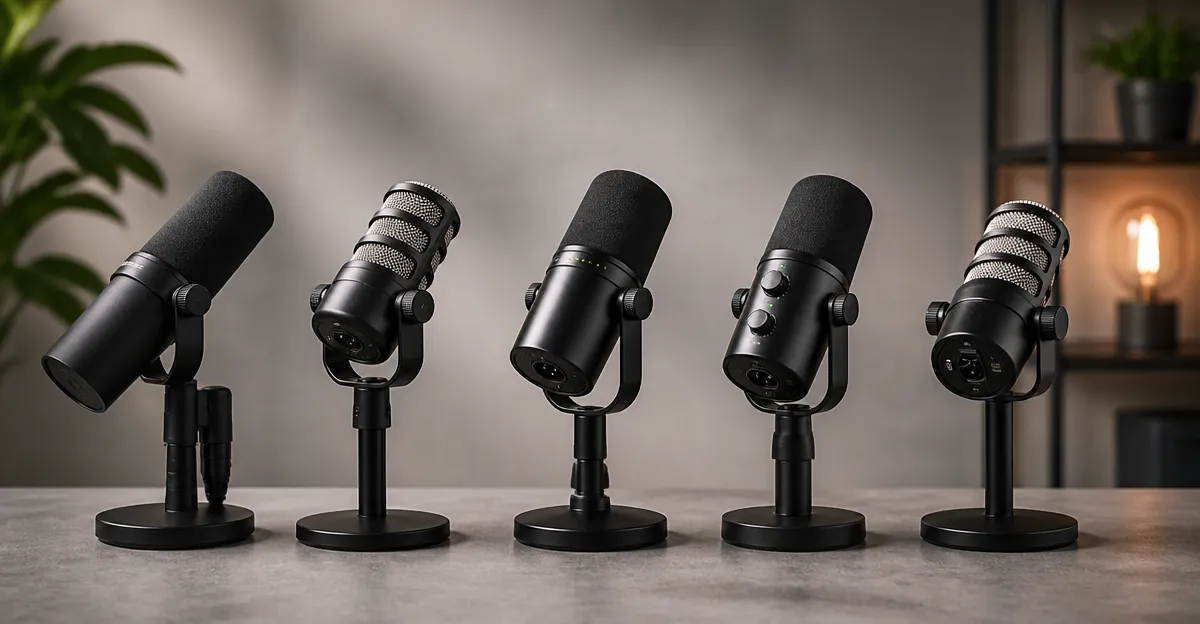
This article provides a comprehensive comparison of five dynamic microphones that are frequently selected by podcasters, streamers, and content creators. The products evaluated are the Shure SM7B, Rode PodMic, Shure MV7+, FIFINE K688CT, and Rode PodMic USB. Understanding the distinctions among price, features, compatibility, and real‑world performance is essential for making an informed purchasing decision that aligns with budget constraints, studio space, and technical requirements.
Individual Product Overviews
Shure SM7B
The Shure SM7B is a professional‑grade dynamic microphone praised for its warm, natural vocal reproduction. It features a cardioid pickup pattern, built‑in air suspension shock isolation, and an internal pop filter. The microphone connects via a standard 3‑pin XLR output and is housed in a rugged all‑metal chassis. At a price of $439.00 it targets serious broadcasters and studio engineers.
Rode PodMic
The Rode PodMic delivers broadcast‑quality sound in a compact dynamic design. It includes an internal pop filter, shock‑mounting, and an all‑metal body. The microphone requires an XLR interface and is priced at $86.00, making it an attractive entry‑level option for podcasters seeking professional tonal characteristics without a large financial outlay.
Shure MV7+
The Shure MV7+ combines the heritage of the SM7B with modern connectivity. It offers both USB‑C and XLR outputs, a customizable LED touch panel, auto‑level mode, real‑time denoising, and built‑in reverb effects. Priced at $299.00, it is positioned as a versatile solution for creators who desire plug‑and‑play simplicity while retaining the ability to upgrade to a full studio chain.
FIFINE K688CT
The FIFINE K688CT is a dynamic microphone kit that supports both USB and XLR connections. It includes a boom arm, gain knob, headphone monitoring jack, and a shock‑mount system. At $79.99 it offers a balanced feature set for beginners and intermediate creators who require flexibility between plug‑and‑play and traditional interface workflows.
Rode PodMic USB
The Rode PodMic USB merges the classic PodMic capsule with dual connectivity. It provides XLR and USB‑C outputs, on‑board APHEX digital signal processing, and a zero‑latency headphone monitor. With a price of $189.00 it targets users who want immediate USB usability while preserving the option to transition to an XLR rig.
Head‑to‑Head Comparison
Price and Value
- Shure SM7B – $439.00; premium price reflects robust construction and industry‑standard sound quality.
- Rode PodMic – $86.00; exceptional value for a broadcast‑grade dynamic mic.
- Shure MV7+ – $299.00; mid‑range price justified by dual connectivity and built‑in DSP features.
- FIFINE K688CT – $79.99; budget‑friendly kit that includes a boom arm and USB/XLR flexibility.
- Rode PodMic USB – $189.00; higher than the standard PodMic due to USB‑C integration and DSP.
Features and Specifications
| Feature | Shure SM7B | Rode PodMic | Shure MV7+ | FIFINE K688CT | Rode PodMic USB |
|---|---|---|---|---|---|
| Connectivity | XLR | XLR | USB‑C & XLR | USB & XLR | USB‑C & XLR |
| Built‑in Pop Filter | Yes (detachable windscreen) | Yes (internal) | No (digital processing) | Yes (included windscreen) | Yes (internal) |
| Shock Isolation | Air suspension | Internal shock mount | Digital denoising | Shock mount on boom arm | Internal shock mount |
| Power Requirements | Requires high‑gain preamp (~60 dB) | Standard dynamic gain | USB supplies 5 V; XLR needs preamp | USB supplies 5 V; XLR needs preamp | USB supplies 5 V; XLR needs preamp |
| Additional DSP | No | No | Auto‑Level, Real‑time Denoiser, Reverb | No | APHEX compression & presence |
Customer Ratings and Feedback
All microphones hold ratings above four stars, indicating strong overall satisfaction. The Shure SM7B leads with a 4.8/5 rating from 12,200 reviews, praised for “solid build quality” and “fantastic sound.” A reviewer noted, “the SM7B is an institution; it delivers broadcast‑ready clarity without additional accessories.” The Rode PodMic also carries a 4.8/5 rating from 7,228 reviews; users frequently cite its “heavy, solid feel” and “clear, professional voice.” One user wrote, “the sound is excellent, making my voice sound clear and professional for Discord and streaming.” The Shure MV7+ holds a 4.7/5 rating from 1,109 reviews; feedback highlights “out‑of‑the‑box sound quality” and “convenient USB‑C operation.” A reviewer stated, “the voice clarity is outstanding, background noise is greatly reduced.” The FIFINE K688CT receives a 4.5/5 rating from 1,371 reviews; customers appreciate its “clear, crisp sound” and “sturdy boom arm.” One comment reads, “the kit offers excellent value for the price.” The Rode PodMic USB has a 4.2/5 rating from 1,304 reviews; users value the dual connectivity but some experience intermittent USB failures. A negative review mentions, “the mic would stop working and required unplugging, which was inconvenient.”
Performance and Reliability
In professional studio environments, the SM7B is renowned for consistent performance, but its low sensitivity demands a high‑gain preamp such as a Cloudlifter. The need for additional hardware can increase total system cost. The Rode PodMic delivers reliable performance with minimal setup, yet its “hefty” weight may require a robust boom arm. The MV7+ excels in flexible workflows; its auto‑level mode adapts to varying speaker distances, reducing the need for manual gain adjustments. The FIFINE K688CT offers comparable sound quality at a lower price point, though the USB mode lacks the advanced DSP of the MV7+. The PodMic USB provides built‑in APHEX processing, simplifying tonal shaping for users who lack external plugins, but occasional USB stability issues have been reported.
Size, Power, Compatibility, and Price Summary
- Size: The SM7B measures 198.7 mm × 117 mm × 96 mm and weighs 851.6 g, making it the largest and heaviest. The PodMic and PodMic USB are similarly heavy metal units, while the MV7+ is lighter, and the K688CT includes a compact boom arm.
- Power: Only the USB‑capable models (MV7+, K688CT, PodMic USB) draw power directly from a computer. The XLR‑only models require an external preamp or mixer for phantom‑free operation.
- Compatibility: All microphones are compatible with standard 3‑pin XLR inputs. USB‑compatible models work with Windows, macOS, iOS, and Android via the supplied cable.
- Price: The range spans from $79.99 (FIFINE K688CT) to $439.00 (Shure SM7B), providing options for tight budgets and premium setups alike.
Pros & Cons
Shure SM7B
- Pros: Exceptional sound quality, robust all‑metal construction, built‑in pop filter, industry‑standard XLR connectivity.
- Cons: Requires high‑gain preamp, higher overall cost when auxiliary gear is considered, heavy and bulky.
Rode PodMic
- Pros: Broadcast‑grade tone at a low price, internal pop filter, solid metal body, excellent off‑axis rejection.
- Cons: Requires XLR interface, weight may demand a sturdy mount, no USB option.
Shure MV7+
- Pros: Dual USB‑C and XLR, auto‑level and real‑time denoising, customizable LED panel, built‑in reverb effects.
- Cons: Higher price than basic dynamic mics, USB cable not included, XLR use still needs an interface.
FIFINE K688CT
- Pros: USB and XLR flexibility, included boom arm, intuitive controls, competitive price.
- Cons: USB mode lacks advanced DSP, function keys disabled when using XLR, no built‑in EQ switches.
Rode PodMic USB
- Pros: Dual connectivity, APHEX DSP for compression and presence, zero‑latency headphone monitoring.
- Cons: Reported intermittent USB reliability, heavier than comparable USB‑only mics, higher price than the standard PodMic.
Recommendations Based on Specific Constraints
Limited Budget (<$100): The FIFINE K688CT offers the best value, delivering both USB and XLR connectivity, a sturdy boom arm, and solid sound quality for under $80.
Need for Plug‑and‑Play USB with No Additional Gear: The Shure MV7+ provides a seamless USB‑C experience, auto‑level adjustment, and built‑in denoising, eliminating the need for an external preamp.
Maximum Audio Fidelity for Professional Broadcast: The Shure SM7B remains the benchmark, assuming the user can invest in a suitable high‑gain preamp such as a Cloudlifter.
Compact Space with Dual Connectivity: The Rode PodMic USB occupies a modest footprint while offering both XLR and USB, making it suitable for small home studios that may later expand.
Purely XLR‑Based Setup with Emphasis on Voice‑Only Applications: The Rode PodMic delivers broadcast‑quality sound at a fraction of the cost of premium models, ideal for voice‑only podcasts.
Frequently Asked Questions
- Do I need an audio interface for the Shure SM7B? Yes; the SM7B has low sensitivity and typically requires an interface that can provide at least 60 dB of clean gain, or an inline preamp such as a Cloudlifter.
- Can the Rode PodMic be used without an XLR interface? No; the PodMic is a dynamic microphone that outputs a balanced XLR signal and therefore needs an audio interface, mixer, or a device with XLR input.
- Is the Shure MV7+ suitable for recording music instruments? While the MV7+ excels at vocal and spoken‑word content, its frequency response (50 Hz‑20 kHz) and dynamic design make it usable for certain instruments, but it may not capture the full nuance of acoustic guitars or drums as a condenser would.
- What advantage does the APHEX DSP in the Rode PodMic USB provide? The APHEX digital signal processing adds compression and presence to the signal, allowing users to achieve a polished, broadcast‑ready tone without external plugins.
- How does the built‑in denoiser of the MV7+ differ from external software? The MV7+ processes noise reduction in real time at the hardware level, reducing latency and ensuring consistent background suppression even when the user moves within the microphone’s pickup range.
- Can the FIFINE K688CT be used as a USB microphone on a laptop? Yes; the kit includes a USB cable that allows direct connection to a laptop, and the built‑in gain knob and headphone monitoring simplify on‑the‑fly adjustments.
- Is a boom arm necessary for any of these microphones? While not strictly required, a boom arm or sturdy stand improves ergonomics and reduces desk‑borne vibrations. The heavier models such as the SM7B, PodMic, and PodMic USB benefit most from a robust mounting solution.
Conclusion
Each microphone examined serves a distinct market segment. The Shure SM7B stands as the premium choice for professionals who can accommodate its gain requirements and budget. The Rode PodMic offers broadcast‑grade sound at an entry‑level price, ideal for creators focused on voice‑only content. The Shure MV7+ bridges the gap between plug‑and‑play convenience and studio‑grade flexibility, making it the best all‑round option for those who anticipate growth. The FIFINE K688CT provides the most economical path to dual connectivity, while the Rode PodMic USB supplies a versatile hybrid solution for users who value built‑in DSP but must be aware of occasional USB stability concerns. Prospective buyers should align their selection with budget, required connectivity, and studio space, remembering that additional gear such as preamps or boom arms may be necessary for optimal performance.