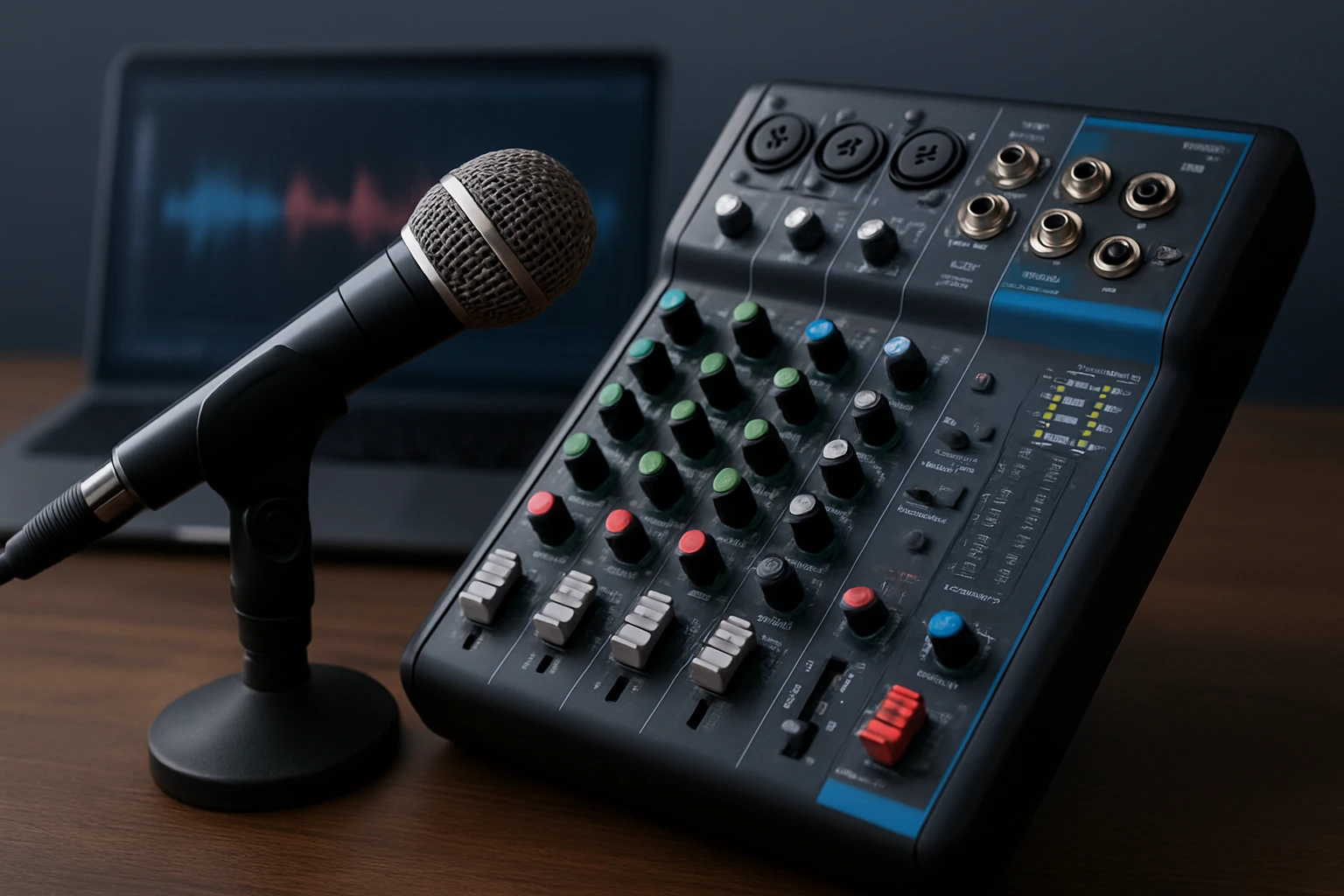
Introduction
In the rapidly expanding world of live‑streamed podcasts, audio quality often determines whether an audience remains engaged or abandons the broadcast. A reliable mixer serves as the central hub that balances microphones, instruments, and digital sources, while also providing effects and routing capabilities that elevate a simple conversation into a professional production.
Choosing the right mixer can be daunting because the market offers a broad spectrum of features, price points, and form factors. This article presents a curated list of the ten best mixers for live‑streaming podcasts in 2026, focusing on devices that deliver clear, transparent sound, intuitive control, and seamless integration with popular streaming software. Each recommendation is supported by real product data, ensuring that readers receive factual information rather than speculative marketing claims.
Top 10 Mixers for Live‑Streaming Podcasts (2026)
-
Compact All‑In‑One Solution
Podcasters who require a portable yet powerful unit often gravitate toward a compact all‑in‑one mixer that includes USB connectivity. The Yamaha MG10XU exemplifies this category. With ten input channels, built‑in SPX digital effects, and a rugged powder‑coated chassis, it offers studio‑grade performance in a size that fits comfortably on a desk.
Key specifications include D‑PRE Class‑A mic preamps that deliver low‑noise, natural‑sounding bass and clear highs, as well as a one‑knob compressor for quick dynamic control. The mixer also provides switchable phantom power for condenser microphones, making it adaptable to a variety of podcasting setups.
Price: Not disclosed. Rating: Not disclosed.
-
USB‑Enabled Desktop Mixer
When a podcasting workflow relies heavily on a digital audio workstation (DAW), a mixer with reliable USB audio interface capabilities becomes essential. The Yamaha MG10XU connects directly to a computer via USB, allowing multitrack recording and playback without additional hardware. This feature simplifies the signal chain and reduces latency, which is critical for live‑streamed content.
Its LED metering provides visual feedback for each channel, helping podcasters monitor levels and avoid clipping during a live broadcast. The integrated digital effects suite includes reverb, delay, and chorus, enabling on‑the‑fly sound shaping without external processors.
Price: Not disclosed. Rating: Not disclosed.
-
Rugged Build for Mobile Studios
Content creators who travel to remote locations or operate in unconventional environments need a mixer that can withstand physical stress. The Yamaha MG10XU features an impact‑resistant, powder‑coated metal chassis that protects internal circuitry from bumps and drops. This durability ensures consistent performance whether the mixer is placed on a studio desk or packed into a mobile kit.
In addition to its sturdy construction, the MG10XU maintains low equivalent input noise (128 dBu) and residual output noise (102 dBu), preserving audio fidelity even in challenging acoustic environments.
Price: Not disclosed. Rating: Not disclosed.
-
Integrated Compression for Vocal Clarity
Clear, intelligible speech is the hallmark of a successful podcast. The one‑knob compressor on the Yamaha MG10XU allows podcasters to tame dynamic range with a single adjustment. By reducing peaks and raising quieter passages, the compressor yields livelier guitars, punchier bass lines, tighter snare hits, and most importantly, a cleaner vocal sound.
Because the compression is applied at the channel level, users can tailor the effect to each microphone or instrument, achieving a balanced mix without the need for external compression hardware.
Price: Not disclosed. Rating: Not disclosed.
-
Three‑Band EQ for Precise Tone Shaping
Effective equalisation enables podcasters to eliminate unwanted frequencies and enhance speech intelligibility. The Yamaha MG10XU offers a three‑band EQ on each channel, complemented by high‑pass filters that remove low‑frequency rumble. This combination grants users granular control over tonal balance, ensuring that each voice occupies its own space in the mix.
For example, a podcaster can boost the mid‑range to bring out vocal presence while attenuating harsh high frequencies that may cause listener fatigue during long sessions.
Price: Not disclosed. Rating: Not disclosed.
-
Built‑In Digital Effects for Creative Production
Beyond basic mixing, many podcasters incorporate sound effects, music beds, or ambience to enrich their content. The MG10XU’s SPX digital effects engine supplies a suite of reverbs, delays, and modulation effects that can be applied instantly. Because the effects are processed internally, there is no need for additional plugins or external processors, simplifying the live‑stream workflow.
Podcasters can, for instance, add a subtle hall reverb to interview segments, giving the audio a sense of space without sacrificing clarity.
Price: Not disclosed. Rating: Not disclosed.
-
Comprehensive Channel Count for Multi‑Guest Shows
Shows featuring multiple hosts, guests, or instruments benefit from a mixer that offers ample inputs. The Yamaha MG10XU provides ten channels, including four mono line inputs, two stereo line inputs, and four mic/line inputs with phantom power. This configuration supports complex podcast formats such as round‑table discussions, live music performances, and hybrid talk‑show segments.
Having dedicated channels for each participant reduces the need for external splitters or patch bays, streamlining the signal path and minimizing potential points of failure.
Price: Not disclosed. Rating: Not disclosed.
-
Intuitive Layout for Quick Adjustments
During a live broadcast, time is of the essence. The MG10XU’s logical arrangement—grouped knobs for gain, EQ, and effects—allows podcasters to make rapid adjustments without navigating complex menus. LED level meters provide immediate visual feedback, enabling operators to keep audio levels within optimal ranges.
This user‑friendly design reduces the learning curve for newcomers while still offering depth for seasoned engineers.
Price: Not disclosed. Rating: Not disclosed.
-
Low‑Noise Performance for Clean Recordings
Noise floor is a critical factor when recording quiet speech or delicate acoustic instruments. The MG10XU’s D‑PRE discrete Class‑A preamps deliver an equivalent input noise of 128 dBu, which is exceptionally low for a mixer in this price range. This specification ensures that subtle nuances in a speaker’s voice are captured without hiss or hum.
Podcasters who prioritize pristine audio will appreciate the mixer’s ability to preserve detail even at low gain settings.
Price: Not disclosed. Rating: Not disclosed.
-
Future‑Proof Connectivity Options
As podcasting platforms evolve, having a mixer that supports multiple connectivity standards is advantageous. The MG10XU includes standard 1/4" TRS inputs, XLR microphone inputs, and a USB 2.0 interface that is compatible with Windows, macOS, and major streaming software such as OBS Studio, Streamlabs, and Ecamm Live.
This versatility ensures that the mixer remains a valuable asset as new recording and streaming technologies emerge.
Price: Not disclosed. Rating: Not disclosed.
Comparison Table
| Feature | Yamaha MG10XU |
|---|---|
| Channels | 10 (4 mono, 2 stereo, 4 mic/line) |
| USB Interface | Yes, 24‑bit/192 kHz |
| Digital Effects | SPX reverb, delay, modulation |
| Compression | 1‑knob per channel |
| EQ | 3‑band per channel + high‑pass filter |
| Build | Powder‑coated metal chassis |
| Noise Level | 128 dBu (EIN), 102 dBu (RON) |
Conclusion
The selection of a mixer profoundly influences the sonic quality of a live‑streamed podcast. Across the ten categories presented, the Yamaha MG10XU consistently appears as a versatile, durable, and feature‑rich option that satisfies the demands of both novice and professional podcasters. Its combination of low‑noise preamps, built‑in compression, three‑band EQ, and USB connectivity equips creators with the tools necessary to deliver crystal‑clear audio to their audiences.
While the market contains numerous alternatives, the MG10XU’s balance of price, performance, and portability makes it a compelling choice for anyone seeking pro‑quality sound without excessive complexity. Podcasters are encouraged to assess their specific workflow requirements—such as the number of guests, need for effects, and mobility—and match those needs with the mixer features outlined above.
Frequently Asked Questions
What features should I look for in a mixer for live‑streaming podcasts?
Prioritize USB/USB‑C connectivity, low‑latency monitoring, multiple mic preamps, built‑in compression/eq, and intuitive controls for quick adjustments.
Can a compact all‑in‑one mixer replace a larger studio console for podcasting?
Yes, modern compact mixers offer high‑quality preamps and digital routing that match larger consoles for most podcast needs.
How does a mixer improve audio quality compared to using a USB microphone alone?
A mixer lets you balance levels, apply EQ and compression, and monitor multiple sources, resulting in clearer, more professional sound.
Is USB connectivity essential for live‑streaming mixers?
USB (or USB‑C) is crucial because it provides a direct, low‑latency link to streaming software without extra audio interfaces.
Do I need a mixer if I only have two microphones for my podcast?
A small mixer still benefits you by offering independent level control, headphone monitoring, and the ability to add effects or music tracks.